
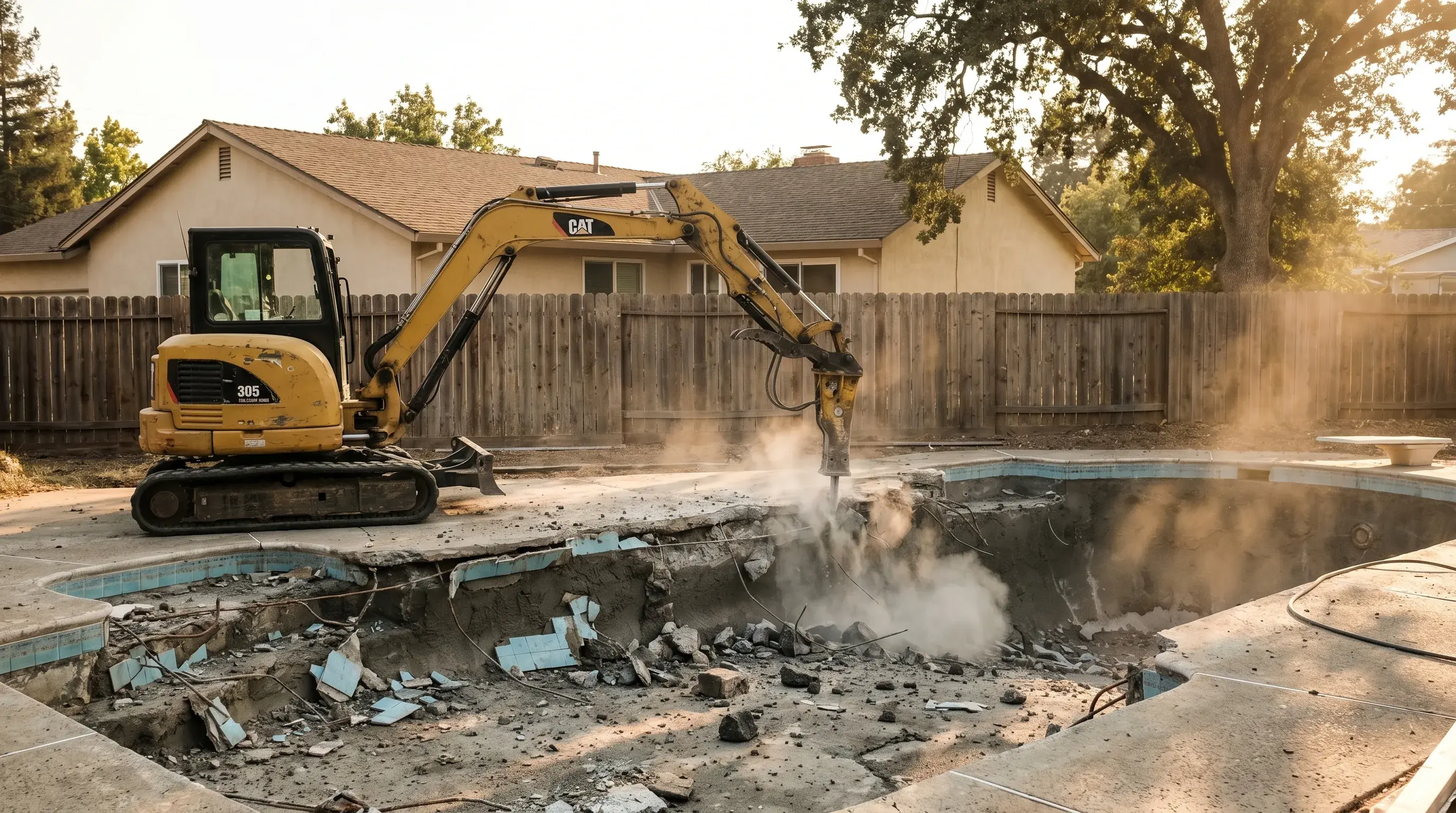
Can you actually build an ADU where your pool is?
Yes, with three conditions: complete pool removal (no partial cap), imported engineered fill compacted to at least 90% per ASTM D1557, and a geotech sign-off when the new foundation lands over the former pool footprint. Between 2020 and 2024, the City of Sacramento issued 1,134 ADU permits, with year-over-year growth of roughly 16% from 2023 to 2024 (City of Sacramento ADU Resource Center, 2024).
A lot of those backyards used to hold a pool. We see the pattern every quarter: aging gunite shell, kids grown, owner wants rental income or housing for a parent.
The catch? Almost half the homeowners who call us assume a partial fill-in is enough. It isn't. Sacramento County won't permit a habitable structure over a pool shell that's still in the ground, no matter how nicely it's been capped.
If you're early in the planning stage, our Sacramento pool demolition page walks through what a full removal looks like on a typical Sacramento lot, and the excavation, engineered fill, and compaction that follow are the site preparation half of the job. The decision to demo a pool for an ADU isn't really a demo decision; it's a foundation decision wearing demo clothing.
Sacramento's 2026 ADU rules in plain English
ADUs accounted for 19% of all new California housing in 2022, and Sacramento County alone added 1,071 ADUs to the tax roll between 2020 and 2024, up from just 78 in the prior five years (California HCD ADU Handbook, 2024). The rules tightened on owner-occupancy and loosened on approval timelines. Here's what actually applies.
Standard ministerial approval is 60 days, not 30. The 30-day path only applies to detached ADUs built from a preapproved plan (AB 1332), like the Sacramento County Shelf-Ready set. Owner-occupancy is no longer required for standard detached ADUs. AB 1154 (effective January 1, 2026) narrows the JADU owner-occupancy rule so it applies only when the JADU shares a bathroom with the primary dwelling.
Setbacks default to 4 feet from the side and rear property lines. Height tops out at 16 feet for a standard detached unit. Lot coverage rules cannot be used to block an 800 sq ft ADU sitting at 4-foot setbacks. Impact fees are waived for any ADU 750 sq ft or smaller.
Sacramento County publishes free Shelf-Ready ADU Plans that qualify for that 30-day review: Models A1, A2, B, C, and D, ranging from 500 to 1,200 sq ft. Plans are pre-engineered, which is the single biggest design-time saver if your lot fits one of the standard footprints.
60 days is standard. 30 days is pre-approved-plans only. Don't confuse the two when planning your timeline.
Should you demo first, or apply for both permits together?
This is the question that decides your timeline. Two paths, real tradeoffs, and most homeowners pick the wrong one on instinct.
Path A (Sequential): pull the demo permit first. Remove the pool. Get the compaction certification stamped. Then submit the ADU permit with the geotech report attached. You're adding 4 to 8 weeks to the calendar, but the documentation handoff to the ADU reviewer is clean. If something goes sideways on compaction, you find out before you've paid for ADU plans.
Path B (Concurrent): both permits filed at the same time. Faster overall, but you're running on the assumption that compaction will pass on the first test. If it comes in under 90%, the ADU permit can stall mid-review while you re-compact and re-test.
For most homeowners we work with, Path A is the right call. We recommend Path B only when you're locked into a rate or a tight construction window and you've already had a geotech engineer pre-evaluate the site. A pro builder on Fine Homebuilding's forum recommended pouring the ADU foundation before backfilling the pool entirely if both happen in parallel, citing the headache of working around 'a 15-by-40-foot hole in the ground between the jobsite access point and the area where form boards need to be set.'
On a Carmichael job last spring, a homeowner ran the concurrent path to save 6 weeks. First compaction test came in at 87%, three points light. We re-lifted the top 18 inches, brought in another 12 cubic yards of fill, and re-tested. Passed at 91%. But the ADU plan reviewer flagged the gap during the back-and-forth, and the permit sat in queue for an extra 11 days while we resubmitted the corrected geotech letter. Net savings versus sequential: about 10 days, not 6 weeks.
Why full removal is non-negotiable for an ADU
Partial fill-in works for landscaping. It works for a patio. It does not work under a habitable structure, and Sacramento County won't permit it. Three reasons: stiffness discontinuity (the buried pool walls don't compress like surrounding soil), drainage failure (water finds the shell and pools against your new foundation), and code (the County treats a buried shell as an undocumented fill condition).
Contra Costa County, Cupertino, and La Cañada Flintridge all publish the same standard. The language varies, but the rule is identical: no structures over partially-removed pools. Sacramento City and County are aligned with that.
Worth noting: this is also why a partial fill is rarely 'cheaper in the long run.' If you ever want to sell to a buyer planning an ADU, or build one yourself five years later, you're paying to dig it back up. Our full vs. partial pool removal breakdown gets into the cost math on that specifically.
Newsweek's pool-fill story flagged the red flags: 'big debris, no layering, no compaction, or no drainage and grading plan.' If your contractor offers any of those, walk away.
What compacted engineered fill actually means
Compacted engineered fill is imported clean fill placed in lifts of 8 inches or less, with each lift compacted to at least 90% relative density per ASTM D1557 (Modified Proctor) before the next lift goes in. A licensed civil or geotechnical engineer signs off on each layer.
Note the engineer type. We hear 'structural engineer' a lot from homeowners. That's the wrong specialty. Compaction certification is a civil or geotechnical engineer's job. A structural engineer designs the ADU's frame and foundation; the geotech certifies what's underneath it.
Now the myth we hear weekly: 'fill needs 1 to 2 years to settle before you can build.' That's true for non-engineered fill. Native soil dumped in a hole and tamped down with a wheel loader, sure, give it a year or two. Engineered fill, placed in lifts and compaction-tested per ASTM D1557, is structurally ready the day the geotech stamps the report. That's the entire point of engineering it.
A Carmichael couple called us in 2024 after a previous owner had done a partial fill in 2017. They wanted to build a 720 sq ft ADU on the back corner of the lot, which crossed the old pool footprint by about 11 feet. We had to excavate the cap, pull the buried shell pieces, haul them off, re-import 47 cubic yards of engineered fill, and re-certify. Their total demo-and-fill bill came to roughly 2.5x what a full removal in 2017 would have cost. The homeowner who did the partial in 2017 saved about $7,000. The 2024 owners paid an extra $18,000 to undo it.
| Spec | Requirement | Source |
|---|---|---|
| Pool shell removal | Entire shell — no partial cap | Sacramento County standard |
| Relative compaction | ≥90% per ASTM D1557 | ASTM International |
| Lift thickness | Max 8 inches, compacted before next lift | ICC code |
| Fill type | Imported engineered fill (no pool debris) | Sac County Building |
| Certification | Stamped by civil OR geotechnical engineer | Sac County permit closeout |
Utility disconnects: the part most homeowners miss
This is the step almost every homeowner forgets. Pool electric, gas heater, and water service all need formal disconnect documentation before the ADU permit reviewer signs off on new connections.
SMUD handles electric service disconnects at 1-888-742-7683. SMUD's fees page lists the current service-removal charges. PG&E gas cap-and-cut is requested through 1-877-743-7782 or the PG&E gas service removal portal. The gas line gets cut as close to the main as practical, with both ends capped. Water service abandonment varies by purveyor: City of Sacramento Utilities, Sacramento Suburban, or Cal-Am, depending on your parcel.
Here's the trap. The ADU permit reviewer asks for utility-disconnect confirmation on the pool side before approving the new connections to the ADU. If the demo crew leaves utility cleanup to you, your ADU permit holds. We sequence utility disconnects in the first week of any demo job for exactly this reason.
The permit stack: demo, ADU, and the soils report
Sacramento City and Sacramento County both treat demo and ADU as separate permits. Plan on two applications, two review cycles, and two sets of fees. ADU permit fees inside the City of Sacramento run $4,800 to $14,200 or higher, depending on size and finishes (City of Sacramento ADU Resource Center, 2024). Unincorporated Sacramento County runs lower, roughly $3,000 to $12,000.
Soils reports are situational, not universal. The County typically requires one when the new foundation falls over the former pool footprint, when the lot has known expansive soils, or when the geotech engineer flags it during compaction certification. If your ADU sits on undisturbed ground and only the patio extends over the old pool area, you may skip it. Ask the County during your pre-application meeting; don't assume.
| Item | City of Sacramento | Sacramento County (unincorp.) |
|---|---|---|
| ADU permit fees | $4,800–$14,200+ | $3,000–$12,000 |
| Pool demo permit | Required, separate | Required, separate |
| Impact fees | Waived ≤750 sq ft | Waived ≤750 sq ft |
| Soils report | Situational | Situational |
| Pre-approved plans | Available | Shelf-Ready (free) |
Where the surrounding suburbs fit
Pre-approved plans are the single biggest design-cost saver. Custom architectural plans for a small ADU run $6,000 to $14,000. The County's Shelf-Ready set is free if one of the five models fits your lot. The catch: Shelf-Ready footprints are fixed. If you want a galley kitchen instead of a U-shape, you're back to custom.
For homeowners in surrounding jurisdictions, the process is similar but the fee structure shifts. Our Sacramento demolition and land clearing page covers Sacramento proper, and we work the same playbook in Carmichael, Citrus Heights, Fair Oaks, and Orangevale. These 1960s-70s tract neighborhoods carry the densest backyard-pool inventory in the region, which is why they're also the densest ADU-permit zones.
The full cost stack from drained pool to finished ADU
Total combined cost from drained pool to keys-in-hand ranges from roughly $258,000 to $458,000 for a mid-range detached ADU between 600 and 800 sq ft. The pool demo and fill portion is the smaller line; the ADU build itself is where 85% of the budget lives.
Line-by-line ranges, based on current Sacramento-region pricing:
Where the savings are, and where they aren't:
- Where to cut: Shelf-Ready plans save $6K to $14K outright. Pre-approved permit processing trims weeks of holding costs if you're carrying a construction loan. Site access matters more than people realize; a clear 10-foot path to the backyard knocks demo time and price down meaningfully.
- Where not to cut: compaction. The Newsweek story we mentioned earlier — homeowner saves $4,000 on the fill spec, ADU cracks within two years, fix costs $35,000 plus the lawyer's bills. Compaction is the single line item where shortcutting costs the most downstream.
- Our pool demolition cost guide breaks down the demo portion in more detail. For the pad-prep side, our ADU pad preparation guide covers what happens between 'fill certified' and 'foundation poured.'
| Line item | Range | Notes |
|---|---|---|
| Pool demolition (concrete/gunite) | $8,000–$15,000 | Full removal, includes haul-off |
| Pool demolition (fiberglass) | $6,000–$12,000 | Lighter shell, easier removal |
| Imported engineered fill | $1,000–$2,500 | 40–60 cu yd × $15–$40/cu yd |
| Geotech compaction cert + soils | $1,500–$4,000 | Combined when both required |
| Demo + ADU permits | $7,800–$26,200 | Both jurisdictions |
| Architectural plans | $0–$14,000 | Shelf-Ready = $0; custom = $6K-$14K |
| Detached ADU build (600–800 sq ft) | $240,000–$410,000 | Mid-range finishes |
| Combined total | ~$258K–$458K |
Will this trigger a property tax reassessment?
Yes, but only partially. Under Prop 13 and Prop 19, the ADU itself is reassessed at current market value. Your existing home's assessment doesn't change (Sacramento County Assessor — Prop 19). Removing the pool, on its own, doesn't trigger a reassessment either; pools are landscape features, not assessed living area.
The Sacramento County Assessor uses roughly $180 per square foot of new living area as a baseline. Math on a typical 700 sq ft ADU: 700 × $180 = $126,000 in added assessed value. At a 1.05% effective rate, that's about $1,300 per year in added property tax.
An Orangevale owner we worked with in 2023 estimated $700 a year in added tax based on Zillow comps. Real bump came in at $1,420, roughly double her estimate. Not catastrophic, but worth running through your monthly rental-income math before you sign the permit application. If your ADU rents at $2,200/month, the $118/month tax bump is noise. If you're building for a parent and not renting it out, it's the only ongoing cost you can't avoid.
Common mistakes that kill the project
We see the same seven mistakes repeatedly. Each one is fixable on day one and painful to fix on day 200.
- Partial pool removal. Disqualifies the site for any future structure. The County won't permit over a buried shell. Period.
- Skipping compaction certification. The ADU permit reviewer will reject the submittal. No certification, no foundation approval.
- Using pool debris as backfill. Banned under Sacramento County's fill spec. Imported engineered fill only.
- No soils report when the foundation crosses the pool footprint. The geotech may waive it, but get the waiver in writing.
- Forgetting SMUD and PG&E sequencing. New ADU utility connections wait on documented pool-side disconnects.
- Hiring separate demo and ADU contractors with no documentation handoff. Compaction reports, lift logs, and utility disconnect confirmations need to land in the ADU GC's hands. If neither party owns the handoff, paperwork goes missing.
- Choosing partial fill to 'upgrade later.' A do-it-right-the-first-time full removal in 2026 runs roughly 40% of what a 2031 redo costs after you've sat with a buried shell for five years.
What our project data shows on sequencing
Across the pool-to-ADU jobs we've quoted in the Sacramento metro since 2022, sequential-path projects came in on average 18 days slower start to permit-issuance, but with 64% fewer mid-review hold-ups. Concurrent-path projects were faster when they worked and significantly slower when they didn't. The median outcome favors sequential.
If you're ready to walk through the sequencing for your specific lot, contact our team and we'll do a site visit. We handle pool demo, engineered fill, grading, pad preparation, and excavation as a single scope, which is the cleanest documentation handoff a permit reviewer can ask for.
Frequently asked questions
Can I keep part of the pool and build the ADU offset to the side?
- Only if the ADU foundation, footings, and required setbacks land entirely on undisturbed native soil and the patio or hardscape over the pool is clearly non-structural. The County treats anything within the pool's overdig zone (typically 2 to 3 feet beyond the shell wall) as suspect fill. In practice, if your lot is tight, a partial pool retention rarely works because the offset eats into your setback margins.
How long does the entire pool-to-ADU process take in Sacramento?
- Plan on 8 to 14 months end to end. Pool demo and engineered fill: 2 to 4 weeks. Compaction certification: 1 week. ADU permit review: 60 days standard, 30 days with pre-approved Shelf-Ready plans. Construction: 5 to 9 months for a detached unit. Sequential path adds 4 to 8 weeks but reduces mid-review hold-ups significantly (City of Sacramento ADU Resource Center, 2024).
Does an ADU lower or raise my property value?
- It raises it. Sacramento-area ADUs typically add $150,000 to $300,000 in market value, depending on size, finishes, and rentability. The Sacramento County Assessor uses roughly $180 per sq ft for new living area on the tax bill, but market value usually runs higher because appraisers credit the rental income stream. Removing a pool to build the ADU is generally neutral to slightly positive for resale.
Can I do the pool demo as an owner-builder and hire a GC for the ADU build?
- Legally yes, practically risky. The compaction documentation, lift logs, and utility-disconnect confirmations all need to be airtight when the ADU GC submits for permits. Owner-builders who haven't run an engineered fill job before often miss a document or skip a lift test, and the ADU permit then waits while you backfill the paperwork. Most homeowners save money by hiring one contractor for both scopes.
Do I need a soils report on every Sacramento ADU?
- No. Soils reports are situational. They're typically required when the ADU foundation crosses the former pool footprint, when the lot has known expansive soils (parts of Elk Grove, Galt, and Wilton flag this), or when the geotech engineer recommends one during compaction work. Ask the County during your pre-application meeting. Plan for it in your budget, but don't assume it's automatic.
How do I qualify for the Sacramento County Shelf-Ready ADU Plans?
- Your lot needs to be in unincorporated Sacramento County (not City of Sacramento, Folsom, Elk Grove, or Citrus Heights), your selected model footprint needs to fit within your setbacks and lot coverage limits, and your soil conditions need to match the standard engineering assumptions in the plan set. Five models are available: A1, A2, B, C, and D. The plans themselves are free, but you still pay the permit fees (Sacramento County Shelf-Ready ADU Plans, 2024).
Get an estimate
Need this work done? Request a free estimate for Pool Demolition
Remove unwanted pools, concrete, debris, and prepare the area for your next backyard project.
Need this work done? Request a free estimate for Earthwork & Grading
Full earthwork scope — clearing, cut and fill, import and export, compaction, rough and finish grade.
Need this work done? Request a free estimate for Pad Preparation
Level, usable areas prepped for ADUs, shops, garages, and outbuildings.
Need this work done? Request a free estimate for Excavation
Dirt removal, trenching, small excavation, rough grading, and site support work.
Go deeper
Cost Guides
How Much Does Pool Demolition Cost in Sacramento, CA?
Sacramento pool demolition cost ranges — what drives price, full vs partial removal, and what to expect from a real estimate.
Demolition Guides
Full vs Partial Pool Removal: What's the Difference?
Side-by-side comparison of full and partial pool removal, including resale, cost, and future-use implications.
Site Prep Guides
ADU Pad Preparation: Clearing, Grading & Access
What it takes to turn an existing backyard or lot into an ADU-ready pad.
Related posts
Compliance & Permits
Sacramento Heritage Oak Permits: 2026 Grading Guide
When grading, ADU pad work, or demo on your Sacramento-region lot triggers heritage oak rules — DBH thresholds, fees, fines, and TPZ specs by jurisdiction.
Cost & Market
Mobile Home Demolition in Sacramento: 2026 Cost Guide
What it really costs to tear down an old singlewide or doublewide on owned land in the Sacramento region — plus the asbestos survey, SMAQMD notice, and HCD title steps that catch owners off guard.