
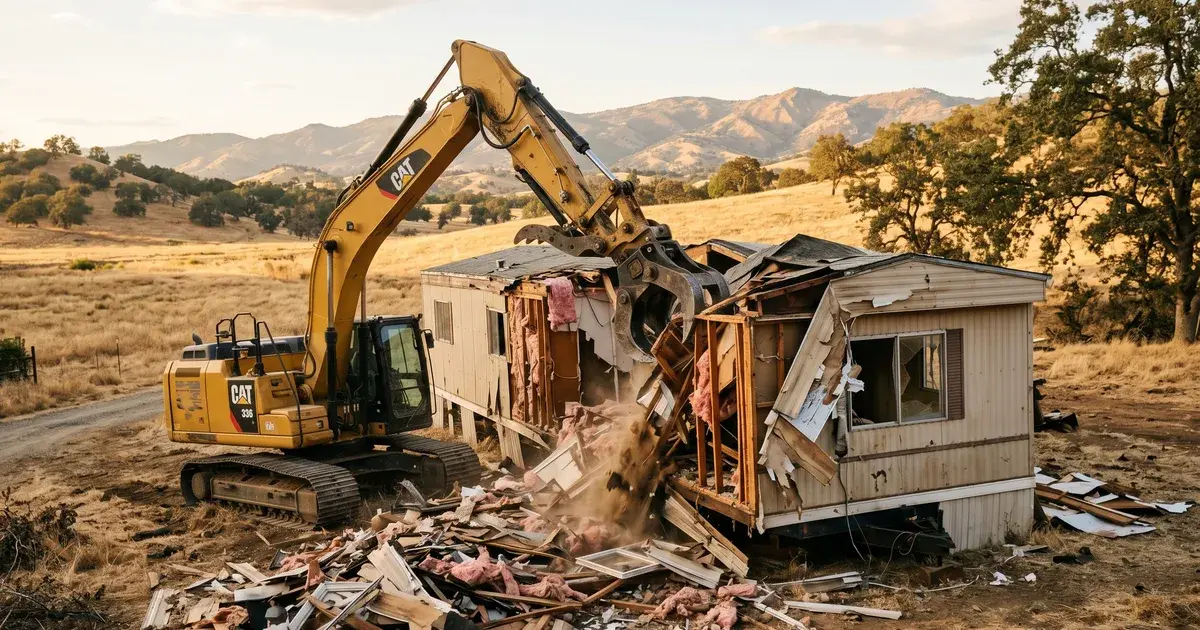
How much does mobile home demolition cost in Sacramento?
Tearing down a mobile or manufactured home in the Sacramento region typically runs $3,000 to $6,000 for a singlewide and $5,000 to $8,000 for a doublewide, including haul-off — before asbestos abatement, foundation removal, or disposal surcharges. National contractor pricing lands around $2 to $5 per square foot for the structure (HomeGuide, 2026). The trap is that the demo itself is the cheap part. The regulated steps — asbestos survey, air-district notification, and title cancellation — are what separate a $4,000 invoice from a $14,000 one.
Most owners we talk to are sitting on a unit from the 1970s or 1980s on a rural or older-tract lot: an inherited property, a manufactured home being replaced with a stick-built house or ADU, or a fire/flood-damaged unit that has to come down. The structure comes apart fast. What costs money is doing it legally — and in California, "legally" means asbestos and a vehicle-style title you have to formally kill.
Here's the realistic cost stack on a Sacramento-area job. Treat the structure and disposal lines as the floor and the asbestos line as the swing factor:
| Line item | Cost range | Notes |
|---|---|---|
| Singlewide demolition + haul | $3,000–$6,000 | Structure only; access-dependent |
| Doublewide demolition + haul | $5,000–$8,000+ | Larger footprint, two sections |
| Asbestos survey (Cal/OSHA CAC) | $400–$800 | Required before demo on older units |
| Asbestos abatement (if found) | $2,000–$10,000+ | Only if regulated material is present |
| SMAQMD asbestos notification | $435 | Single demo / <500 sq ft (.gov fee) |
| Utility disconnects | $200–$800 | Electric, gas cap, water abandonment |
| Slab / pier foundation removal | $500–$3,000 | Pier-and-beam cheaper than poured slab |
| Demolition permit (if applicable) | $100–$500 | Foundation status decides this — see below |
| **Typical all-in (no abatement)** | **$5,000–$11,000** | Singlewide to doublewide |
| **All-in with abatement** | **$8,000–$18,000+** | Older unit, regulated asbestos found |
The single biggest cost variable isn't the size of the home — it's whether an asbestos survey turns up regulated material. On a pre-1980 unit, assume it will until a certified consultant says otherwise.
Why do old mobile homes almost always need an asbestos survey?
Manufactured homes built before 1980 commonly contain asbestos in vinyl sheet flooring and its paper backing, duct wrap, cement siding panels, roofing, and textured surfaces — and demolition is exactly the activity that makes those materials friable and airborne (EPA Asbestos NESHAP overview). That's why California requires a certified Cal/OSHA asbestos consultant to survey the structure and identify all regulated asbestos-containing material *before* any demolition begins. You can't skip the survey by assuming the home is clean.
The survey isn't optional paperwork. SMAQMD — the Sacramento Metropolitan Air Quality Management District — states plainly that the owner must "first retain a certified Cal/OSHA asbestos consultant to conduct your asbestos survey" ahead of a teardown (SMAQMD asbestos page). A survey on a typical singlewide runs $400 to $800. If it comes back clean, you've spent the cost of a survey to make the rest of the job simple. If it finds regulated material, a licensed asbestos abatement contractor has to remove that material before the demo crew touches the structure.
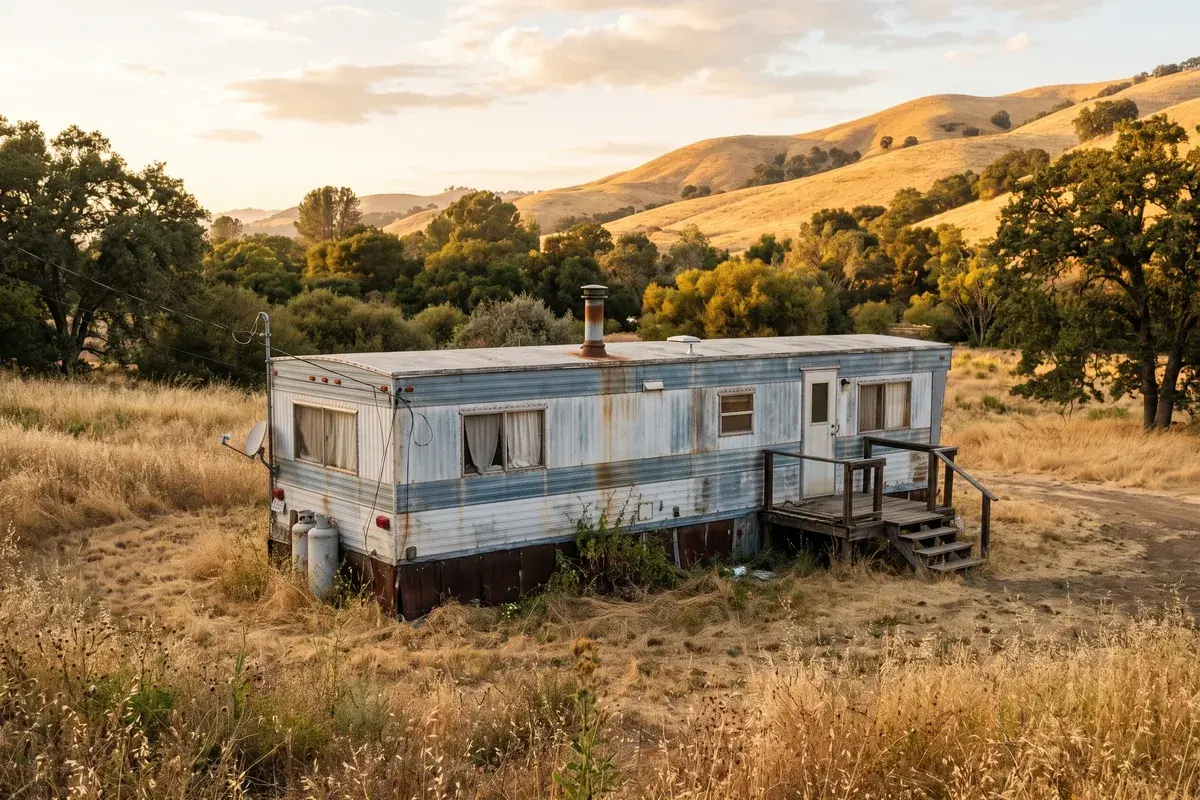
Where asbestos hides in an older manufactured home:
- **Vinyl and sheet flooring** — plus the paper backing and mastic underneath, the most common find.
- **Duct wrap and furnace components** — heating ducts run under the floor in most singlewides.
- **Cement siding and skirting panels** — asbestos-cement board was standard on many units.
- **Roofing and textured ceilings** — built-up roofing felts and popcorn ceiling texture.
- **Pre-1978 paint** — older units can also carry lead-based paint, which adds OSHA worker-protection and disposal handling on top of asbestos (EPA RRP).
Do you have to notify the air district before the teardown?
Yes — and this is the step that surprises people. Federal law (the asbestos NESHAP, 40 CFR 61.145) requires written notice to the local air district at least 10 working days before any demolition begins, and that notice is required even when the survey finds no asbestos at all (Cornell LII — 40 CFR 61.145). In the Sacramento region, you or your abatement contractor file that asbestos demolition notification with SMAQMD under its Rule 902 program.
SMAQMD's standard fee for a single demolition project or a small abatement under 500 square feet is $435, filed on the district's Asbestos Renovation/Demolition Notification Form (SMAQMD asbestos in building materials). Here's the part that affects your schedule: in most Sacramento-area jurisdictions, the building department won't release the demolition permit until SMAQMD has signed off on the notification. Skip the air-district step and your permit stalls — or worse, you draw an enforcement penalty for demolishing without notice.
What the asbestos notification step actually involves:
- A certified Cal/OSHA consultant survey identifying any regulated material.
- Abatement by a licensed contractor first, if regulated material is found.
- The SMAQMD notification form filed at least 10 working days before demo ($435 standard).
- SMAQMD sign-off, which most building departments require before issuing the demo permit.
The 10-working-day clock is the most-missed deadline on a mobile home teardown. Even a clean, asbestos-free unit needs the notification filed before equipment shows up. Build those two weeks into your schedule.
Permit or title cancellation: which one applies to your unit?
Whether you need a building-department demolition permit depends entirely on how your mobile home is legally classified, and that comes down to its foundation. A manufactured home on a recorded permanent foundation (an HCD Form 433A) is treated as real property affixed to the land — that path generally needs a demolition permit from the city or county building division, just like a stick-built house. A unit that's still registered through HCD on a vehicle-style title is personal property, and the controlling step there is canceling the registration, not pulling a structural demo permit (Sacramento County Assessor — mobile & manufactured homes).
Most owned-land teardowns we see in the Sacramento region are the personal-property kind — an older unit on piers that was never converted to a 433A foundation. That doesn't make it permit-free. You still need utility disconnects, the asbestos notification, and the HCD title cancellation. It just means the building department's demo permit may not be the document that governs your job. Confirm your unit's status with the Sacramento County building division before you assume which track you're on — City of Sacramento and unincorporated county handle this differently.
Two tracks, depending on foundation:
- **On a recorded 433A foundation (real property):** demolition permit from the building division, plus utility disconnects and the asbestos notification.
- **Registered through HCD (personal property):** HCD title/registration cancellation, utility disconnects, and the asbestos notification — verify with the building department whether a demo permit also applies.
- **Either way:** the asbestos survey and the SMAQMD 10-day notice apply. Foundation status doesn't change those.
How do you cancel the HCD title after the home is gone?
When a registered mobile home is destroyed or demolished, you declare it salvage with California's Department of Housing and Community Development (HCD) — the agency that titles manufactured homes like vehicles. You file a Statement of Facts for Salvage Units (Form HCD 486.4), surrender the Certificate of Title or DMV ownership certificate, the last registration card, and the HCD decals and HUD labels, and HCD issues a Salvage Certificate retiring the unit from registration (HCD — Salvage Units). The full step-by-step is in HCD's cancellation of title and registration procedures.
Don't skip the property-tax piece. If the unit was on local property taxation, you have to notify the county assessor that it was declared salvage — "or a tax liability may be assessed against the registered owner" (HCD). We've watched this exact mistake play out: an owner near Rancho Cordova demolished an inherited 1972 singlewide in 2024, hauled everything off clean, and then kept getting property-tax bills for a home that no longer existed. The fix took a salvage filing and a letter to the Sacramento County Assessor — work that should have happened the same week as the demo, not a year later. The structure was gone; the tax record didn't know it.
The home being physically gone doesn't end your obligations. Until you file the HCD salvage paperwork and notify the assessor, the county can keep taxing a unit that's already in the landfill.
What does asbestos abatement add to the bill?
If the survey finds regulated asbestos, abatement typically adds $2,000 to $10,000 or more to the job, depending on how much material is present and where (Angi asbestos removal cost, 2026). On a small singlewide with asbestos limited to floor covering, you're usually at the low end. On a doublewide with siding, duct wrap, and roofing all testing positive, the number climbs. Abatement is licensed, regulated work — it isn't a line you can DIY off the invoice.
Disposal is the other asbestos cost, and it's significant. Non-friable asbestos goes to a landfill cell rated for special handling: at Sacramento County's Kiefer Landfill, that's $347.80 per ton, versus $61.35 per ton for ordinary refuse and $28.45 per ton for clean mixed inerts (Sacramento County Waste Management & Recycling — Kiefer fees, effective 2026). Friable asbestos is more restricted and has to route to a facility permitted to accept it — confirm the destination with your abatement contractor, since not every site takes friable material. The takeaway: the more asbestos the survey finds, the more the disposal tonnage shifts from the $28–$61 rate into the $347 rate.
What drives the abatement number up or down:
- **Quantity and type of material** — floor-only is cheap; siding plus roofing plus ducts is not.
- **Friable vs. non-friable** — friable material has stricter handling and disposal routing.
- **Disposal tonnage** — special-handling tonnage at Kiefer is roughly 5–6x the rate of ordinary debris.
- **Access** — a tight foothill lot slows controlled removal and adds labor.
Where does the debris go, and what does dumping cost?
A demolished mobile home is mostly metal, wood, and mixed construction debris, and a good contractor separates it to keep disposal cost down. Scrap steel from the chassis and frame goes to a metal recycler (often a small credit back, not a cost). Clean inerts — concrete from a slab or piers — go to Kiefer Landfill at $28.45 per ton. General mixed debris is charged as refuse at $61.35 per ton, with a $45 minimum charge on weighed loads under a ton (Sacramento County WMR — Kiefer Landfill fees). Sorting matters: dumping everything as mixed refuse is the most expensive way to do it.
This is where hiring a contractor who does both demolition and debris hauling under one scope pays off — the crew that knows the Kiefer rate structure separates loads at the jobsite instead of paying the refuse rate on recoverable inerts and metal.
| Material | Rate | Use case |
|---|---|---|
| Clean mixed inerts | $28.45 / ton | Concrete slab, pier footings |
| Ordinary refuse (MSW) | $61.35 / ton | General mixed demo debris |
| Special handling (non-friable asbestos) | $347.80 / ton | Regulated asbestos material |
| Minimum charge (weighed loads <1 ton) | $45.00 | Small loads, prorated |
Singlewide vs. doublewide: what actually moves the price?
Size is the obvious driver, but it's not the only one. A singlewide is one transportable section, usually 600 to 1,300 square feet, and comes apart and hauls in fewer loads. A doublewide is two sections joined on site, often 1,500 to 2,500 square feet, which means more structure, more disposal tonnage, and often more asbestos surface area if the unit is old. But on real jobs, foundation type and site access swing the price as much as square footage.
A pier-and-beam singlewide on a flat lot with a clear path for equipment is the easy case — quick teardown, cheap foundation removal at $500 to $1,500. A doublewide on a poured slab at the end of a narrow foothill driveway is the hard case: more demo, slab removal at $1,000 to $3,000, and a longer haul to a transfer point. On a Cameron Park job, the unit was a modest doublewide, but the only equipment access was a 9-foot-wide gravel drive with a hard turn at the top. We staged smaller equipment and ran more trips — the access, not the home's size, set the price.
Cost factors beyond square footage:
- **Foundation type** — pier-and-beam removal ($500–$1,500) is cheaper than a poured slab ($1,000–$3,000+).
- **Site access** — a narrow or steep driveway means smaller equipment and more loads.
- **Asbestos surface area** — more square footage of regulated material means more abatement and special-handling disposal.
- **Distance to disposal** — rural foothill lots add haul time to Kiefer or a transfer station.
- **Add-ons** — decks, carports, sheds, and skirting all add debris tonnage.
The clean teardown sequence, start to finish
The cheapest mobile home demolition is the one that runs in the right order. Reverse a couple of these steps and you're paying for delays, a stalled permit, or a tax bill on a home that's already gone. Here's the sequence we run on Sacramento-region jobs, and it's the same whether your unit is on piers or a permanent foundation.
When you're ready to scope your specific property, contact our team for a site walkthrough. We handle the house and mobile home demolition, debris hauling, concrete and foundation removal, and site preparation for whatever comes next — a new manufactured home, a stick-built house, or an ADU pad — as a single scope, which keeps the asbestos, disposal, and permit documentation in one place. We work Sacramento, Rancho Cordova, Elk Grove, Auburn, Placerville, Cameron Park, Grass Valley, Lincoln, and the surrounding metro and foothill counties.
The order that keeps a mobile home teardown clean:
- **Asbestos survey** — certified Cal/OSHA consultant inspects before anything else.
- **Abatement** — licensed contractor removes regulated material, if any is found.
- **SMAQMD notification** — filed at least 10 working days before demo ($435 standard).
- **Utility disconnects** — electric, gas cap-and-cut, and water abandonment documented.
- **Permit or salvage track** — demo permit (433A foundation) or confirm the personal-property path.
- **Demolition and haul** — separate metal, inerts, and refuse to control disposal cost.
- **HCD salvage filing + assessor notice** — cancel the title and stop the property tax.
Frequently asked questions
Do all old mobile homes contain asbestos?
- Not all, but enough that you can't assume yours is clean. Manufactured homes built before 1980 commonly contain asbestos in flooring, duct wrap, cement siding, and roofing — and demolition makes it airborne. California requires a certified Cal/OSHA asbestos consultant to survey the home before demolition. A survey runs $400 to $800; if it comes back clean, the rest of the job is simpler and cheaper. If it finds regulated material, a licensed contractor must abate it first.
Can I demolish my own mobile home in California?
- You can hire and coordinate the work, but the regulated steps can't be DIY'd. The asbestos survey must be done by a certified Cal/OSHA consultant, abatement (if needed) by a licensed asbestos contractor, and the asbestos demolition notification filed with SMAQMD at least 10 working days before work begins. You'll also need utility disconnects and, for an HCD-registered unit, a salvage title filing. Most owners hire one demolition contractor to manage the whole sequence rather than juggle it themselves.
How long does the SMAQMD asbestos notification take?
- The federal asbestos NESHAP requires the notification to be filed at least 10 working days before demolition starts, and that applies even if the survey finds no asbestos. SMAQMD's standard fee is $435 for a single demolition or a small abatement under 500 square feet. Because most Sacramento-area building departments won't release the demolition permit until SMAQMD signs off, plan on roughly two weeks of lead time for this step before equipment can mobilize.
What happens to my property taxes after I remove a mobile home?
- You have to tell the county. When a registered mobile home is demolished, you file a salvage declaration with California HCD (Form HCD 486.4) and notify the county assessor that the unit was declared salvage. If you don't notify the assessor, a tax liability can still be assessed against you for a home that no longer exists. Owners are sometimes surprised to keep receiving property-tax bills after a clean teardown — the fix is the salvage filing plus written notice to the Sacramento County Assessor.
Should I demolish, sell, or donate an old mobile home instead?
- Donation and resale only make sense for a structurally sound, relocatable unit — and a home old enough to carry asbestos is rarely a good relocation candidate. Moving a mobile home has its own permit, transport, and re-setup costs that often exceed its value. For a deteriorated pre-1980 unit on owned land, demolition is usually the practical path, especially when you're clearing the lot for a replacement home or ADU. Run the numbers on relocation before assuming it's cheaper than a teardown.
Get an estimate
Need this work done? Request a free estimate for House Demolition
Demolition for houses, garages, sheds, outbuildings, small buildings, and light commercial structures.
Need this work done? Request a free estimate for Hauling & Debris Removal
Remove brush, concrete, dirt, demolition debris, green waste, and jobsite material.
Need this work done? Request a free estimate for Concrete Removal
Break, remove, and haul concrete from patios, driveways, pool decks, slabs, and demo projects.
Need this work done? Request a free estimate for Site Preparation
Clearing, demolition, grading, hauling, and equipment work to prep your property.
Where this applies
Go deeper
Cost Guides
How Much Does House Demolition Cost in Sacramento?
Sacramento house demolition cost ranges, square-foot examples, permits, asbestos survey timing, and what a quote should include.
Demolition Guides
Sacramento County Demolition Permit Guide
When demolition permits, utility disconnects, asbestos review, historic review, and inspections apply in Sacramento.
Demolition Guides
How to Hire a Demolition Contractor in Northern California
Questions to ask before hiring a demolition contractor for permits, utilities, disposal, asbestos, insurance, and site handoff.
Related posts
Compliance & Permits
Pool Removal Before an ADU Build: Sacramento Guide
What it takes to convert a Sacramento backyard pool into an ADU pad — sequencing, compaction specs, permit stack, and the full cost picture.
Compliance & Permits
Sacramento Heritage Oak Permits: 2026 Grading Guide
When grading, ADU pad work, or demo on your Sacramento-region lot triggers heritage oak rules — DBH thresholds, fees, fines, and TPZ specs by jurisdiction.