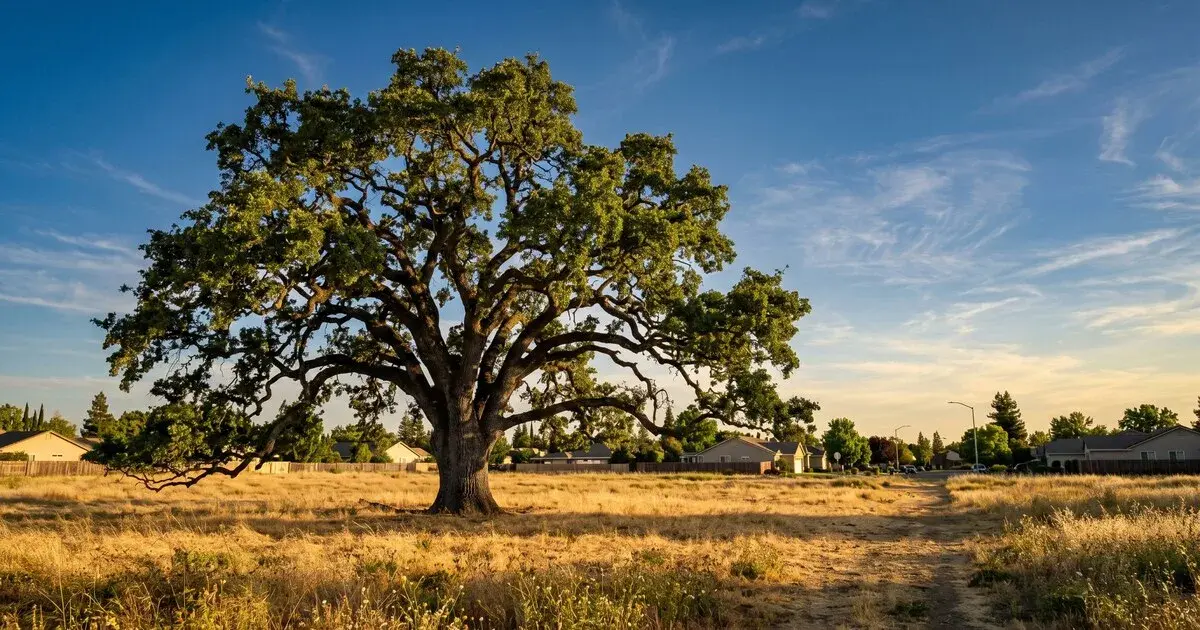
When does a tree on your Sacramento lot trigger a permit?
In the Sacramento metro region, almost any native oak with a trunk diameter of 5 to 6 inches or more is protected by ordinance — Placer County triggers at 5", Sacramento County and most cities trigger at 6" (measured 4.5 feet above ground, called DBH for diameter at breast height). Once a tree is protected, almost any grading, demolition, or trenching work entering its dripline needs a permit before equipment moves.
The trigger isn't whether you own the tree or whether you're planning to cut it down. It's the species, the size, and where your project lines fall relative to the dripline and root zone. Native oaks — valley oak, blue oak, interior live oak, coast live oak, Oregon white oak — are the protected species in nearly every Sacramento-region ordinance.
The mistake we see most: homeowners assume that because they're not removing the tree, no permit is needed. Wrong. Sacramento County's Chapter 19.12 regulates damage as well as removal. Grade cuts greater than 1 foot inside the dripline, fill placed within the protected zone, trenching through root systems, even compaction from equipment parked under the canopy — all of it can trigger a code violation.
Sacramento is pushing hard on canopy growth. The city's Urban Forest Plan (adopted 2025) targets 35% canopy by 2045, up from 19% today. That requires roughly 25,000 trees planted per year and zero tolerance for unauthorized loss of mature trees already on the ground (Sacramento City Express, June 2025). Enforcement has teeth right now and is getting stricter, not looser.
If you're planning any work where a mature oak sits within 25–40 feet of new construction, treat the tree review as a hard prerequisite — not a maybe.
What counts as a heritage oak in Sacramento, Roseville, Rocklin, and Placer?
Every jurisdiction in the Sacramento region writes its own ordinance — there is no single "heritage oak" definition. Sacramento County uses ≥60" DBH for heritage status. El Dorado County drops it to ≥36". Citrus Heights wrote its own rules separate from Sacramento County. Placer County's Article 19.50 (not the older 15.48 some sources still cite) triggers protection at just 5" DBH — the lowest threshold in the region.
Here's the side-by-side. This comparison doesn't exist in one place anywhere else we've found:
| Jurisdiction | Ordinance | DBH trigger | Heritage / fee | Penalty |
|---|---|---|---|---|
| Sacramento County | Ch. 19.12 | Native oak ≥6" single / ≥10" agg. | ≥60" DBH heritage; $31.95 | Misdemeanor + in-kind replacement |
| City of Sacramento | Ch. 12.56 | Native oaks of any size | ~12" DSH native oak | $250–$25,000/violation |
| Citrus Heights | Ch. 106.39 | Oak ≥6" / other ≥19" | $32.24; 50% native replant | Up to $25,000/day |
| Roseville | Ch. 19.66 | Native oak ≥6" | Inch-for-inch replacement | Mitigation + civil |
| Rocklin | Ch. 17.77 | Native oak ≥6" | $0 fee; mitigation fund or replant | Mitigation order |
| Placer County (unincorp.) | Art. 19.50 | Oak ≥5" (lowest in region) | Permit-based | $50/scar + mitigation |
| El Dorado County | Ch. 130.39 / Ord. 5061 | Native oak >6" to <36" | ≥36" DBH heritage; in-lieu fee | Permit revoke + fines |
| City of Folsom | Ch. 12.16 (Ord. 1299) | All protected natives | Permit + mitigation | Civil penalties |
Placer County's 5" DBH trigger is the lowest in the region. If your project is in Roseville (city) vs. unincorporated Placer (Granite Bay, Newcastle, Penryn), you're looking at two different rules and two different permit offices.
Which grading and demo jobs actually trigger tree review?
Five project types in the Sacramento region routinely trip protected-tree rules: driveway widening into the dripline, ADU pad work within 25–40 feet of a mature oak, foundation excavation that overlaps the root zone, utility trenching through the protected area, and pool fill or removal where equipment staging pinches the tree. Knowing which one applies before you bid the job is the difference between a clean permit and a stop-work order. This is why we fold the tree review into the grading and site leveling scope up front, and why land clearing in Sacramento on oak-canopy lots starts with a protected-tree survey rather than a blade.
Sacramento County's Tree Preservation Notes spell it out: no grade cuts greater than 1 foot inside the dripline, no fill greater than 1 foot, zero cuts or fill within 5 feet of the trunk, and trenching is flat-out prohibited inside the dripline unless it's bored or directionally drilled.
On a Carmichael ADU project last spring, we showed up for the pre-grading walkthrough and measured the proposed pad footprint: it crossed inside the dripline of a 28" valley oak by about 7 feet. The homeowner had a complete permit set, plans stamped, financing approved — and Sacramento County would have rejected the foundation inspection the moment they saw the tree relationship. We sat with the architect that afternoon, re-sited the pad 9 feet west, and saved both the tree and a four-figure mitigation order. Total redesign time: 45 minutes.
Practical scenarios where protected-tree rules catch people:
- **Driveway widening.** Adding a 3-foot apron to the existing drive routinely pushes equipment into the dripline of street-side oaks.
- **ADU pad over root system.** ADU footprints in the 600–800 sq ft range often land within 30–40 feet of a mature backyard oak — well inside the typical TPZ. See our pool removal before ADU build guide for the sequencing side of this.
- **Foundation footings.** A new addition's footing trench inside the dripline triggers automatic protected-tree review.
- **Utility trenches.** Sewer, gas, water, or electric trenched through root zones must be bored, not dug. If your contractor pulls the trench permit without a tree permit, the inspector will stop the job.
- **Pool fill or removal.** Equipment staging plus the fill volume itself can compact the root zone of an adjacent oak. We've turned away pool demolition jobs where the only viable equipment path crossed under a 30" valley oak with no protection plan.
How close can equipment work to a protected oak?
The Tree Protection Zone (TPZ) is the area defined by the tree's dripline. Industry rule of thumb: 1 foot of TPZ radius per 1 inch of trunk DBH — so a 20" oak gets a 20-foot protected radius, with chain-link fencing installed 3 feet outside the dripline before any grading equipment arrives. Inside that zone, equipment doesn't park, fill doesn't get dumped, and trenches don't get cut.
Fencing isn't decorative — it's the inspector's first checkbox. Sacramento County requires 5-foot chain link installed at the outermost edge of the TPZ before grading begins, with no equipment, storage, or vehicle access inside the fence for the duration of the project (Sacramento County Protective Tree Measures). Rocklin spells out 4-foot minimum fencing located 3 feet outside the dripline (Rocklin Oak Tree Preservation Guidelines).
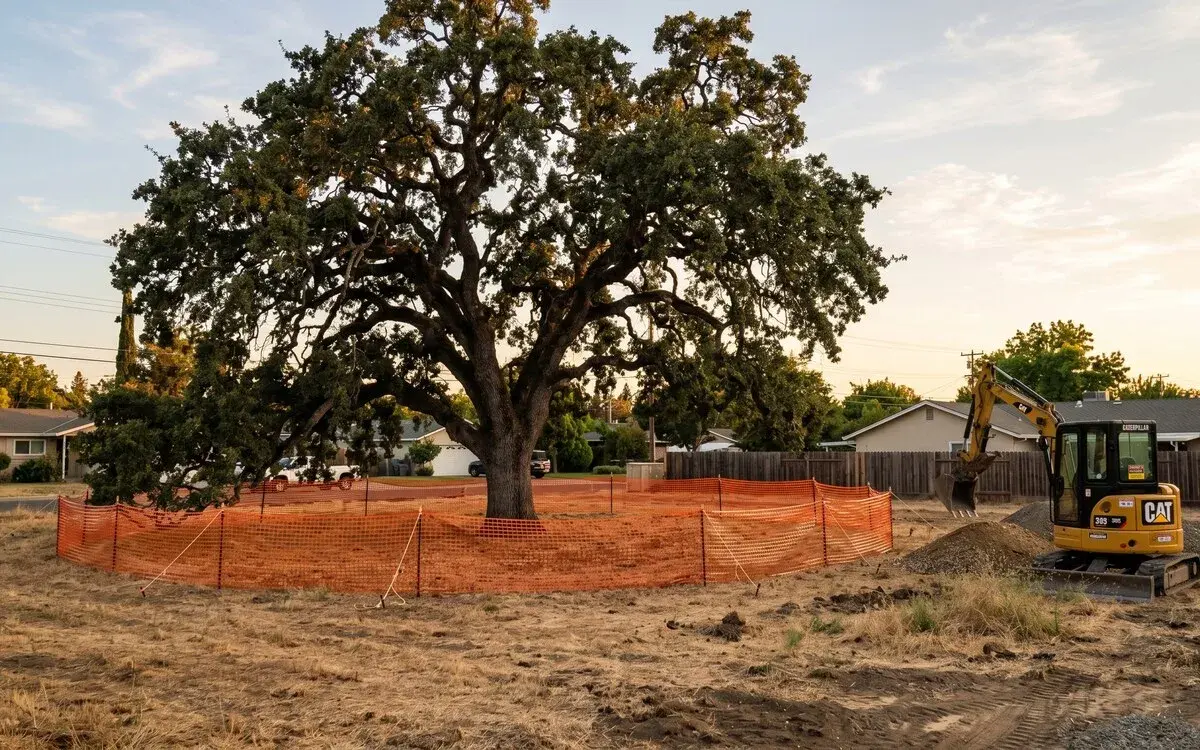
Root cuts inside the TPZ get more restrictive the bigger the root:
- Roots **less than 1 inch** in diameter — can be cleanly pruned with no special treatment.
- Roots **1 to 2 inches** — must be cleanly cut, treated with pruning sealant, and immediately covered with damp earth.
- Roots **2 inches or larger** — **cannot be cut**. Period. They must be left intact, kept moist during exposure, and re-covered as fast as possible.
If you hit a 3-inch root with a trencher, you've got a problem the trencher operator can't solve. That's a stop-the-job, call-the-arborist moment.
What does it cost to do this by the book?
Total cost to comply with heritage oak rules on a typical Sacramento-area teardown or ADU project usually lands between $1,500 and $8,500, depending on tree count, jurisdiction, and whether mitigation plantings or in-lieu fees apply. The permit itself is cheap — $0 to $32 in most cases. The arborist report ($450–$700) and tree protection fencing ($500–$2,000) are where the real budget goes. Mitigation, if required, is the wild card.
Here's what we typically see on Sacramento-region projects:
Where the math goes the wrong direction:
- A $700 arborist report and a $2,000 fencing line look painful at the bid stage. The alternative — the City of Sacramento's $250–$25,000 fine schedule under Sac City Code 12.56 — runs in the opposite direction.
- A Roseville homeowner called us in 2024 after a different contractor cut into roots inside the TPZ of a 22" coast live oak while widening a driveway. The arborist forensic report ran $1,200. The mitigation order from the city: replacement plantings at 1:1 DBH plus a 3-year monitoring program. Total downstream cost ~$8,400. The permit they didn't pull would have cost about $30 plus a $550 arborist report.
- Arborist report price points sourced from gotreequotes.com 2025 industry data; permit fees from each jurisdiction's posted fee schedule.
| Line item | Cost range | Notes |
|---|---|---|
| Permit application | $0–$32 | Free in Rocklin; ~$32 Sac County / Citrus Heights |
| Arborist report (permit-grade) | $450–$700 | Required in Roseville and most discretionary reviews |
| Informal arborist consult | $75–$150 | OK as a first-pass when scope is unclear |
| Tree protection fencing | $500–$2,000 | Chain-link or orange plastic, per jurisdiction spec |
| Mitigation plantings (1:1 DBH) | $250–$3,500 | 15-gallon natives in Sac County |
| In-lieu fee (El Dorado, others) | Varies | Per-inch DBH or per-acre; call the jurisdiction |
| **Typical compliance total** | **$1,500–$8,500** | Single tree, no removal |
| Heritage oak removal w/ full mitigation | $3,500–$12,000+ | Permit + removal + replacements |
What happens if you skip the permit?
Unauthorized removal or damage of a protected oak in the City of Sacramento triggers fines from $250 to $25,000 per violation, with continuing violations assessed at up to $25,000 per day under Sacramento City Code 12.56. Placer County adds a $50-per-scar damage penalty for trees damaged during construction. Sacramento County treats violations as both a misdemeanor and a nuisance, with mandatory in-kind replacement totaling the combined DBH of removed trees.
Enforcement isn't theoretical. Every Sacramento-area jurisdiction has a complaint-driven enforcement model, which means neighbors call. Cities and counties also catch a lot of unauthorized work during routine building inspections — the inspector sees the new pad, sees the missing oak, and the file gets opened.
Fine schedules by jurisdiction:
- **City of Sacramento:** $250–$25,000 per violation; up to $25,000/day for continuing violations; possible criminal sanctions.
- **Sacramento County:** Misdemeanor + nuisance under Ch. 19.12.210; mandatory in-kind replacement totaling the DBH removed.
- **Placer County:** $50 per scar (during construction); mitigation order plus civil penalties for unauthorized removal.
- **Citrus Heights:** Up to $25,000/day for continuing violations under Ch. 106.39.
Permit fees in this region are deliberately low — Sacramento County is $31.95, Rocklin is free. The system isn't designed to make compliance hard. It's designed to make non-compliance unaffordable.
What tree protection fencing passes inspection?
Sacramento County requires 5-foot chain link fencing set at the outermost edge of the Tree Protection Zone. Rocklin allows 4-foot minimum, located 3 feet outside the dripline. Both must be installed before any grading equipment arrives on site. Inspectors check fencing first — if the fence isn't up or it's been moved or damaged, the job stops until it's restored.
Spec differences worth knowing:
- **Sacramento County:** 5-foot chain link, outermost edge of TPZ, no exceptions inside the fence.
- **Rocklin:** 4-foot minimum, 3 feet outside the dripline (per Rocklin guidelines).
- **Roseville:** Per arborist plan; typically equivalent to county standard.
- **Placer County (unincorporated):** Per Protecting Trees During Construction guidance; orange plastic mesh acceptable for shorter durations.
- **Inspector checks:** fence in place before grading equipment arrives, no equipment/materials/vehicles staged inside, no grade cuts or trenches inside the fenced area, fence remains intact for project duration.
- **Wet-season note:** orange plastic mesh that's fine for a 3-week summer job will sag, tear, and need replacement on a 6-month build. Chain link costs more up front and saves inspection drama.
When should you call an arborist vs. a demo contractor first?
On any Sacramento-region project with one or more native oaks within 40 feet of planned work, call the arborist before the contractor. The arborist's report drives the permit application, sets the TPZ on the site plan, and tells the demo contractor where the lines are. Reverse the order and you'll often pay for redesign or remobilization when the tree review catches something the contractor missed.
On a Penryn rural lot in 2025, the homeowner had six mature blue oaks scattered across a 2.3-acre parcel and wanted to clear roughly an acre for a new barn pad and equipment yard. We brought in the arborist first. She tagged four keepers (no removal), two candidates for removal with mitigation, and mapped the TPZ for each keeper on the site plan. Placer County reviewed in eight working days. We installed chain link inside one week, started land clearing the next, and finished without a single permit revision. Total job: $32K with zero stop-work risk.
Cleanest sequence we've seen on Sacramento-area projects:
- Arborist site visit + report — identify protected trees, set the TPZ, recommend mitigation if needed.
- Permit application with arborist report attached — county or city reviews in ~10 working days.
- Tree protection fencing installed — before any equipment mobilizes.
- Demo or grading contractor mobilizes — works to the permit set, inside the fence lines on demo side only.
- Inspector signs off on protection measures — required at start of work in most jurisdictions.
- Exception: if the project is small enough (single small pad, no oaks within obvious reach), the demo contractor can do a first-pass walkthrough. Any uncertainty — arborist first.
How much does an oak permit add to your project timeline?
Sacramento County tree permits are typically issued in under 10 working days when the application includes a complete arborist report and site plan with TPZ marked (Sac County Tree Permits). Cities run 2–6 weeks depending on type of review (ministerial vs. discretionary). Plan on 3–4 weeks for safety on most Sacramento-region projects; expand to 6–8 weeks if multiple trees or heritage status is involved.
Timeline by jurisdiction:
- **Sacramento County:** under 10 working days for routine permits.
- **City of Sacramento:** 2–4 weeks ministerial; longer if discretionary or appealed.
- **Citrus Heights:** 1–2 weeks for routine ministerial permits.
- **Roseville:** 3–5 weeks with arborist report; longer for discretionary.
- **Rocklin:** often issued same-week (no fee, ministerial review).
- **Placer County (unincorp.):** field-issued for minor permits; discretionary review on major projects.
- **El Dorado County:** 4–6 weeks if oak woodland conservation review applies.
What this means for your project plan
The variables that add time, in order of frequency: incomplete arborist report (most common — missing TPZ map or mitigation calc), heritage tree status flagged late, neighbor objection or discretionary appeal, multiple trees requiring batched review.
Build the tree permit timeline into the project schedule, not on top of it. If your construction loan or close date is tied to a hard deadline, start the tree permit on day one of permit prep — not after the building permit comes back.
When you're ready to walk through your specific lot, contact our team. We do site walkthroughs that flag tree triggers before you've committed to a plan set — typically the cheapest hour of project planning you can spend. We work in Sacramento, Carmichael, Fair Oaks, Citrus Heights, Roseville, Rocklin, Folsom, and Auburn — and the rest of the Sacramento metro and Placer/El Dorado foothills.
Frequently asked questions
Do I need a permit to trim a heritage oak in Sacramento?
- Yes, in most cases. Sacramento County's Ch. 19.12 requires a permit for pruning that removes more than 25% of a protected oak's canopy or that includes any branch over 4" in diameter. Citrus Heights requires a permit and arborist consult for any branch over 2 inches. Light maintenance pruning of small branches is typically exempt — but if you're hiring a tree service, confirm whether the work needs a permit before they start.
What's the difference between a Sacramento County tree permit and a City of Sacramento tree permit?
- They're separate ordinances with different thresholds, fees, and penalty schedules. Sacramento County (Ch. 19.12) covers unincorporated areas — Carmichael, Fair Oaks, Orangevale, Rancho Murieta — with a $31.95 permit fee. The City of Sacramento (Ch. 12.56) covers properties inside city limits with potential fines up to $25,000 per violation. If your address is inside the city you submit to the city; if it's unincorporated you submit to the county.
How much will mitigation cost if I have to remove a heritage oak?
- Mitigation in Sacramento County requires replacement plantings totaling the combined DBH of the removed tree in 15-gallon native specimens. A single 30" valley oak removal triggers 30 inches of replacement DBH — typically 10 to 15 new 15-gallon trees at $40–$80 each installed, plus a 3-year monitoring requirement. Total mitigation often runs $1,000–$4,000 per heritage oak removed on top of permit and removal costs. El Dorado County uses an in-lieu fee schedule on top of (or instead of) plantings.
Can I run a utility trench through the dripline of a protected oak?
- Not with an open trench. Sacramento County and most cities require utility lines inside the dripline to be installed by horizontal boring or directional drilling — no open excavation. Boring keeps the surface soil and root structure intact above the line. If your project includes a new sewer lateral, gas service, or electrical run that crosses a protected tree's dripline, scope the bore equipment and bore permit at the same time as the tree permit.
How long does an arborist report add to my project timeline?
- A permit-grade arborist report on a single tree usually takes 1–2 weeks from site visit to delivered PDF. Multi-tree assessments on larger lots can run 2–4 weeks. The county or city then reviews the report as part of the tree permit application — Sacramento County typically issues in under 10 working days once a complete package is submitted. Plan on 3–4 weeks from "call the arborist" to "permit in hand" for a typical single-tree project.
Get an estimate
Need this work done? Request a free estimate for Land Clearing
Clear overgrown lots, brush, vegetation, debris, small trees, and access areas.
Need this work done? Request a free estimate for Earthwork & Grading
Full earthwork scope — clearing, cut and fill, import and export, compaction, rough and finish grade.
Need this work done? Request a free estimate for Pad Preparation
Level, usable areas prepped for ADUs, shops, garages, and outbuildings.
Need this work done? Request a free estimate for Excavation
Dirt removal, trenching, small excavation, rough grading, and site support work.
Need this work done? Request a free estimate for Site Preparation
Clearing, demolition, grading, hauling, and equipment work to prep your property.
Where this applies
Go deeper
Demolition Guides
Sacramento County Demolition Permit Guide
When demolition permits, utility disconnects, asbestos review, historic review, and inspections apply in Sacramento.
Land Clearing Guides
Land Clearing vs Grading: What's the Difference?
Clearing removes what's on the ground. Grading shapes the ground itself. Here's how they fit together.
Related posts
Compliance & Permits
Pool Removal Before an ADU Build: Sacramento Guide
What it takes to convert a Sacramento backyard pool into an ADU pad — sequencing, compaction specs, permit stack, and the full cost picture.
Cost & Market
Mobile Home Demolition in Sacramento: 2026 Cost Guide
What it really costs to tear down an old singlewide or doublewide on owned land in the Sacramento region — plus the asbestos survey, SMAQMD notice, and HCD title steps that catch owners off guard.